Thursday, March 28, 2013
Knights Of The Golden Circle Mp3 Download
Jesse James or Warren Getler
To listen Knights Of The Golden Circle Mp3 just click Play
To download Knights Of The Golden Circle mp3 for free:
1. Right Click -> Save Link As (Save Target As)
2. Change filename to Knights Of The Golden Circle.mp3
3. If Save As Type is not MP3, change to All Files
http://mp3skull.com/mp3/knights_of_the_golden_circle.html


Wednesday, March 27, 2013
John Wilkes Booth Mystery
| I remember as a kid in Enid hearing the story that John Wilkes Booth died in Enid. Just recently I ran across this tidbit from the book "Jessie James Was One Of His Names". |
| ( pages 137 - 138 ): "In a sworn statement at Zephyrhills, Florida, on October 1, 1950, William S. ( Wild Bill ) Lincoln said, 'While trying for years on my own to run down the John Wilkes Booth mystery, I landed right in the middle of the Jesse Woodson James mystery without half trying.' In the spring of 1903 ... McDaniel said ... 'The end is coming for that scoundrel, John Wilkes Booth.... I've spared that rascal's life many times. The Golden Circle just had a meeting down in Texas, and we voted to execute Booth.... We know he's registered at the Grand Avenue Hotel in Enid [ Oklahoma ] tonight under the name of James St. George.'" |
| ( page 139 ): "A half block from the Grand Avenue Hotel that night a young Indian boy was selling lemons from a small basket.The Colonel stopped and said to Wild Bill, 'Have this kid make you about a quart of lemonade, pronto, while I duck into this drug store.' Four Golden Circle agents sat in the lobby while the other three joined the two agents already surrounding the hotel - just in case Booth made a run for it. 'Mr. St. George expects us,' the Colonel told the desk clerk and he started up the steps, followed closely by Wild Bill with a jar of lemon juice. The door was unlocked and the two men could see the shape of a man lying on the bed." |
| ( page 140 ): "'... Being a hot night, Mr. Booth, we brought you something cool to drink. Now, Wild Bill, you talk to Mr. Booth while I fix up his drink.' Jesse went over to the wash stand with the jar of lemonade. Hastily, he pulled two bottles from his pocket and poured pure arsenic into the jar. Then he stirred the mixture with a table fork. He poured the loaded lemonade into a glass. Approaching the bed, Jesse said, 'Now, Mr. Booth, I think you've had enough alcohol for tonight. This lemonade will really fix you up. I personally guarantee it.' ... Booth gasped, went into almost a stage fall, but hit the floor with a thud. Jesse James bent over and felt his heart. 'Deader than a mackerel,' he said. 'Wild Bill, stay here. I'm sending up the four agents in the lobby to go through Booth's luggage. I'll be back in a few minutes.' |
| ( page 141 ): " ... The six men were amazed at the records Booth had kept through the years. After they had finished sorting it, Jesse said, 'You know, men, I'm just glad Booth didn't put all this in that crazy book his lawyer wrote - he could have put a noose around all of our necks!' Colonel James then directed his men to plant just enough evidence around the room so that the U. S. Marshals could identify the dead man as John Wilkes Booth. Then they took the trunk and departed.... Late that afternoon from Guthrie, Jesse had an agent send a telegram to the U. S. Marshal's office telling them John Wilkes Booth was dead and where his body could be found." |
| ( pages 141 - 142 ): " ... Three days later, Jesse, accompanied by Wild Bill and two agents, went back to Enid.... The clerk said, 'Whole bunch of lawmen were here yesterday morning up there in Mr. St. George's room, but his body is still there in the bed. It's starting to turn black-like and is tough as leather.' 'Don't worry, son,' Jesse said, 'we're relatives and we've come to claim his body.' ... Carting the body of Booth back to Guthrie, Jesse looked up a doctor friend and asked him for a diagnosis.'It would appear that this man swallowed so much poison, probably arsenic, that he is permanently preserved. He's like a damn Egyptian mummy!' Through a friendly town marshal, Jesse learned that the federal men had checked out John Wilkes Booth's body and papers in Enid and reported some transient posing as Booth had committed suicide. The report listed the dead man's name as James St. George. Wild Bill wrote years later, 'Was the Booth case still too hot to touch in 1903? I'm sure Dr. Samuel Mudd along with others would have been vindicated, and it would have exposed the earler ill-conceived, hysterical investigation, but the U. S. Marshals just turned their backs on the case. Maybe the U. S. government by 1903 had uncovered the real facts in the Booth case and was too ashamed to admit the big blunders made by the government in 1865.' Under Jesse James' direction, the leathery, mummified body of John Wilkes Booth was put in a special coffin and several of his men took it on an exhibition tour all over the United States. Jesse James III reports the Booth body was owned by a Glencoe, Minnesota, jeweler named Jay Gould, a relative of the financier, who had it stored. 'This was in 1955 and I believe Gould has passed away. What happened to the body? Who knows? Perhaps John Wilkes Booth, hated by both the North and the South, is destined to lie forever unburied and unwanted.'" |
| SO, I started doing a little research and came up with the following newspaper reports: |
| The Houston Daily Post. (Houston, Tex.) 1886-1903, January 18, 1903 |
|---|
| COMMITTED SUICIDE Claimed to Be John Wilkes Booth—Took Poison Guthrie, 0. T., January 17—George an old man, reputed to be wealthy, committed suicide at Enid, O. T., by taking poison. He owned land in Indian Territory and Oklahoma and at Dallas, Texas, Before his death he declared that he was John Wilkes Booth. |
| The Paducah Sun. (Paducah, Ky.) 1898-1906, January 22, 1903 |
IS STILL A MYSTERY
St Louis, Jan. 22.—A telegram to the Globe-Democrat from Guthrie, Ok., says:Old Man Claiming to be John Wilkes Booth Unidentified Man Supposed To Havo Killed Booth Is Summoned to View the Remains BODY IS BEING HELD It is announced here that Boston Corbett the man who was supposed to have shot and killed John Wilkes Booth in a burning Virginia barn after the assasinatlon of President Lincoln, has been summoned from Old Mexico to identify, if possible the remains of D. E. George, the man who committed suicide at Enid, Okla. and announced just prior to his death that he was John Wilkes Booth. It is also stated that secret service men have been summoned from Washington, D.C., for the same purpose and the remains are being held in the morgue pending identification One thing of Interest connected with the above is the fact that Corbett is alleged to be a fugitive from justice having escaped from an asylum in Kansas. George E Smith who came from Colfax, Ia., left for home Monday without making any disposition of the remains. He visited both Enid and El Reno in looking into the property interests left by the suicide. Relative to George being Booth Smith stated he was in possession of no secrets and knew only of Georges own statement in that matter. Smith said: "He may have been Booth. He was a man of wide experience. I knew him about two years and can say he was an extensively traveled man, unusually well informed. He confided his life secrets to me only to a small extent. He had a pact and told of having killed a man in Texas for which crime I think he was acquitted." |
| The St. Louis Republic. (St. Louis, Mo.) 1888-1919, January 22, 1903 |
WAS NOT JOHN WILKES BOOTH.
Oklahoma City. Ok., Jan. 21—C. M. Clark of Oklahoma City stated to-day that D. E. George, who committed suicide at Enid and left a note to the effect that he was John Wilkes Booth, the assassin of President Lincoln, had no connection with the death of Lincoln.Oklahoma Man Who Knew D. E. George Tells Story of His Life. REPUBLIC SPECIAL George was born in Mississippi In 1636 and served as a Major on Bedford Forrest's staff In the Confederate Army. George fought three duels and was wounded many times. After the war, it is said, he killed "Ben" Thompson in a. theater at San Antonio. Tex., and was acquitted. Thompson was a noted Texas "man killer." The killing in the Texas theater probably led up to the Booth story. |
| The Paducah Sun. (Paducah, Ky.) 1898-1906, June 04, 1903 |
THE BOOTH MYSTERY
The recent dispatches slating that a man who committed suicide at Enid, I. T., in January has been identified as John Wilkes Booth, president Lincolns slayer, has revived interest in the somewhat hackneyed mystory of the actors tragic fate. It has been claimed for many years from time to time that Booth was really never shot, captured or killed and sensational stories have flourished for a time and then been exploded as myths. This last one may share the fate of its predecessors, but following it comes the following story from Baltimore, Md.,:One of the Pall Bearers Tells a Sensational Story Says the Body Buried as John Wilkes Booth Was Not That of Booth DEVELOPS INTERESTING STORY Basil Moxley, the veteran doorkeeper at Fords opera house in this city and the sole survivor of the pallbearers who carried what is supposed to be Wilkes Booths remains to the tomb in Green Mount cemetery today made the surprising statement that it was only a mock funeral. The late John T. Ford, theatrical manager, Charles Bishop the comedian and Samuel Glenn wore the other pallbearers. Mr Morley has preserved silence until this time non account of the Booth family. He now says: "I have never cared much about talking in regard to the truthfulness of the statement that John Wilkes Booth was buried in Green Mount cemetery for there has always been a certain amount of doubt existing as to whether or not the assassin of President Lincoln was ever captured killed or even shot. But in order that I might clear up at least one supposition I'll tell you positively that his body is not and never was buried in this city to my knowledge. Certainly the body buried in Green Mount was not that of Booth. "Never were any two things in this world which resembled each other less than that body did John Wilkes Booth. I had known Booth all my life and was a very close to the family which I think Is shown by the fact that they asked me to act as pallbearer at the funeral of the dead man whom they had been led to believe was that of their relative. I saw the body several times and examined it The hair on the dead body was of a reddish brown color, while Booths was black." Mosley says further: "However that mere detail made no difference for we all knew at the time that the body was not that of John Wilkes Booth and my examination was only prompted by curiosity alone not that I believed for one minute that the body was that of the assassin. You see the whole affair was planned by friends of the family and was done for purpose which they deemed imperative. Mrs Booth, the mother of John Wilkes Booth, was naturally nearly prostrated with grief at her sons action and the stories of his horrible death in the barn and latter the report that the government had taken charge of his body only acted as a vehicle to a general breaking down of her system and for a time it seemed as though she would not survive that shock." "Then in order that the affair might become a thing of the past as soon as possible some friends determined that it would be best to bring the body here and bury it in the family lot in Green Mount. Through these friends Mrs. Booth applied to the government for the body. This brought matters to a crisis, for I do not believe that John Wilkes Booth was ever killed in that barn and if any one was slain it was some innocent man who knew nothing of the real assassin." "At any rate it was incumbent upon the government to furnish a body to make good their report that Booth bad been killed and they did so. What we got and what was sent here for the body of John Wilkes Booth is what I have already described to you a red haired man who looked no more like the tragedian than you do yourself." "I am now the only one of the five left all of the others have died. I never will believe that Booth was killed and am confident that he escaped, but how I have never been able to make up my mind, or have I any positive knowledge that he did. Yet the one point that has always caused me to doubt the various stories of his death is that if he was killed why did not some one receive the immense reward offered for his capture dead or alive? You can search all records in Washington or Interview any officials then in office who are now alive and I will wager you will be unable to learn of any reward being paid for the delivery of John Wilkes Booths body to the government." I also remember several rumors to the effect that Booth had been seen at the crossroads near Penmar and I have heard men say that they had drank with him in that locality, but I must say I believe those rumors were of the same material as those hatched out about his death and peculiar burials, the funniest of which is the one told by Captain E. W. Hllliad of Metropolis, Ill., to the effect that he helped to sink the body in the Potomac river." Another incident bearing indirectly on the case is reported by a prominent Paducah man who was talking in the Palmer house last season to young Junius Booth, who is a nephew of John Wilkes Booth, and played here in a Mrs. LeMoyne's company several months ago. He declared to the Paducah man that John Wilkes Booth was never captured or killed, and if he was dead he died a natural death. |
| The National Tribune. (Washington, D.C.) 1877-1917, February 05, 1903 |
SAW BOOTH AFTER DEATH
Capt Silas Owen Deputy State Factory Inspector of New York, now residing at Buffalo, N. Y., ridicules the story of the Oklahoma suicide to the effect that he was Wilkes Booth. Capt Owen was Commander of the U. S. Ship Primrose the last year of the war and while in Washington met John Wilkes Booth several times. The last time was two weeks before the tragedy. He says"Capt Owen Ridicules the Story of the Oklahoma suicide "The next time I saw him was in Fords Theater on the night he shot President Lincoln. I sat in seat D 179, right back of the orchestra, with William H Ford, the Executive Officer of the Primrose. I saw Mrs Lincoln stand up in the Presidents box and scream and saw Booth leap to the stage. This Oklahoma story says that the fellow who claimed to be Booth had a broken leg such as Booth sustained in that leap. Booth did not break his leg then. He only broke a tendon in his ankle. On his way across the stage Laura Keene stopped him and asked him, "What have you done?" For answer he slashed at her with his knife. I can hear the sleeve of her dress rip yet as the knife tore through it. I had a good look at him and recognized him as the man who addressed me less than two weeks before. "I saw him once again. This time he was lying on a tarpaulin on the deck of the Lehigh in the Washington Navy Yard. The Lehigh was in dry dock and the body was laid there. He was dead, dead as a door nail. One bullet had gone through his lungs and another broke his leg. I was allowed on board being a naval officer and being in the company of the Lieutenant of the Lehigh Booths body was buried in a cell under the old Arsenal on the point at Washington. A flagstone in the floor of the cell was raised and the body let down then the stone covered it. I learned this at the time from one of the three named officers who saw the body buried. Three Secret Service men were also in the secret with President Johnson, Secretary of War Stanton and the Attorney General. It stayed there until 1872 when it was removed by members of the Booth family. |
| The Paducah Sun. (Paducah, Ky.) 1898-1906, February 05, 1903 |
MORE BOOTH TALK
It May be John Wilkes Booth Was Not Killed After all A Metropolis Man Recalls Incidents of the Mysterious Burial of Booth OTHER INTERESTING DETAILS Since a man died out west claiming to be John Wilkes Booth many papers of the country have been speculating on the question whether or not Booth was ever really killed as is generally supposed The Metropolis Herald says: "Sundays St. Louis Post-Dispatch contained a startling article concerning a man by the name of D.E. George who recently committed suicide at Enid, Okla., and who just before his death confessed that he was John Wilkes Booth, the murderer of Abraham Lincoln. There was in many ways evidence tending to prove that the mans dying confession was true. "The article is of special interest to Metropolis people from the fact that Captain E. W. Hilliard, of this city, assisted in the final disposition of Booths body, or what was supposed to be Booths body. "To a representative of the Herald Captain E. W. Hilliard read the story and recalled carefully the time when he and five other soldiers took a body down the Potomac river and buried it beneath the waves with the impression that it was that of Booth, and he was quite forcibly impressed with it. "He says the whole affair of Booths capture and the disposition of his body was a peculiar circumstance and shrouded in mystery and while the body was positively identified by a military surgeon it is possible the body was that of some man resembling Booth which had been substituted for the purpose of quieting the country at the time when the authorities realized that they had failed to capture the right man "Captain Hilliard never saw Booth while alive but remembers that he saw what was said to have been an excellent likeness of the man and on the night that he assisted in disposing of the mysterious body he noted the fact that the resemblance was quite similar. However one side of the head and faoe wero badly burned "Mr, hilliard has a letter from Horace L. Trim of Providence, R. I., 59 Lydia street, corroborating his former story of disposition of the body which was published in the Herald during the soldiers reunion here in the fall of 1901. Trim was a first-class boy on the steamer Dragon at the time the body was unwrapped and examined that night and assisted in handling the tarpaulin. "The statement that the real Booth was never captured has been made more than once and now it seems quite plausible." A few years ago a well known man of Unionville, Ill., came to Paducah and told a number of his friends that be had received a latter from John Wilkes Booth who was an old school mate and tbat Booth was running a coffee plantation in BraziL. The story was repeated and copied into the big newspapers, and one or two of them sent staff correspondents to the old mans home across the river to interview him and take photographic copies of the letter. He never showed it to anyone however and subsequently declared it was only a joke but many such incidents as this and the one of the western man who recently died and claimed to be Booth have occurred since the war to arouse momentary interest. |
| The Houston Daily Post. (Houston, Tex.) 1886-1903, February 17, 1903 |
WAS HE JOHN WILKES BOOTH?
An Embalmers Story of a Recent Suicide in Oklahoma Corsicana, Texas, February 15, Jack L. Ogilvie, representing an embalming fluid company of Detroit, Mich., spnt yesterday in this place and told The Post representative a story of the old man who suicided in Oklahoma a few days ago, and who said he was John Wilkes Booth, the man who killed Lincoln. The old man took his life at Enid, O. K., on the last day of December, 1902, and Mr. Ogilvie was in Oklahoma at the time. He was given charge of the body and learned the story of the man. It seems that the old man, who seemed to be at least 70 years old, went to El Reno in November last. He was a cultured man and of sociable disposition and soon made many aquaintances. He dressed well, lived at the best hotel and seemed to have plenty of money. About December 23 he took an overdose of morphine with suicidal intent. Before doing so he sent for the wife of a prominent lawyer there with whom he was very friendly and told her he was Booth, but requested her to keep the secret until he was dead. Physicians were were summoned when it was found that he had taken the drug, and they countered the poison, and the old man recovered. A few days later the lawyer moved to Enid and the old man appeared there. He again took morphine and sent for the lady and to her presence he wrote: "I am John Wilkes Booth, the man who murdered Abraham Lincoln, the greatest man the country ever produced." After his death the lady told of his former confession to her and made a sworn statement to that effect. Before the man was buried an old schoolmate of Booth's, living in Memphis, Tenn., came to Enid to see the remains. Before looking at the body this man told the undertaker that Booth's body could be identified by three marks. One was sort of a wen on the right instep, two peculiar marks on the right arm, and a scar behind the left ear. The body was examined and these markes were there just as the memphis man had described them, and he was thoroughly satisfied that the body was that of his former schoolmate, John Wilkes Booth. |
| The copy of the above is hard to read and the word "wen" is the best I can make it out. I have no idea what it could be as a mark though. |
| New-York Tribune. (New York, N.Y.) 1866-1924, February 19, 1903 |
| .............The sixty-nine acres comprised in the Washington barracks became a military post as far back as 1803, and a regular depot for military supplies located there was burned by the British in 1814. Under the old United States Penitentiary, located there, were buried John Wilkes Booth, who assassinated Lincoln, and Mrs. Surratt and the conspirators with him. who were hanged in the court Of the penitentiary at the same time. When the penitentiary was torn down, however, these bodies were removed to established cemeteries. |
| From Historia 13 July 1922 |
BOOTH LEGEND
Legend tells that John Wilkes Booth, the assassin of Pres. Abraham Lincoln, using the name David E. George, committed suicide in Enid, Oklahoma Territory, in 1903. Booth, a popular and talented southern actor, accomplished his task of assassination on April 14, 1865, and following his escape into Virginia, was shot by Sgt. Boston Corbett of the Sixteenth New York Cavalry. Conflicting stories still exist about the identification of Booth's body, and there were errors made in the identification process along with errors in supplying information to the public about the identification. Legend tells that Boston Corbett, the man who shot Booth against orders, was involved in identifying the body as Booth's; within a short time rumors began to circulate questioning the true identity of the corpse doubts and rumors that continue today among Lincoln/Booth scholars and enthusiasts. At approximately 10:30 a.m. on January 13, 1903, in the Grand Avenue Hotel in Enid, the screaming of a guest who had occupied room number four for three or four weeks brought others to his side; David E. George was soon dead. A doctor diagnosed the cause of death as self-administered arsenic poisoning. Later it was told that the deceased had purchased strychnine that morning at a local drug store. The body was taken to Penniman's Furniture Store, also a funeral home. A coroner's jury soon heard stories about this strange, locally unknown man: he was a house painter who did not know how to paint, who always had access to money but died penniless, who frequented bars and loved alcohol, who often quoted Shakespeare, who knew no one but was known by many outside Enid, who was quoted as saying ". . . I killed the best man that ever lived." After George was embalmed, he was placed in a chair in the window of the furniture store/funeral home so that the public could view him, and a photograph was taken. It was believed that he had a "remarkable likeness" to Booth and that his leg had been broken above the right ankle the same break that Booth had suffered in jumping from the Ford's Theater balcony. However, the doctor who had set Booth's leg reported it to be the left leg. Many Enid citizens believed that if George was Booth, the body should be burned. Just as public interest was beginning to fade, Finis L. Bates from Memphis, Tennessee, arrived in Enid. Bates identified the body as his old friend John St. Helen. Bates had been a lawyer in Granbury, Texas, and claimed to have known St. Helen (George) as a client and friend in the early 1870s. After about five years of friendship St. Helen became seriously ill and believing that he was dying, confessed to Bates that he was Booth. He recovered and later gave a detailed account of his life, the assassination, and the escape, to Bates information that only Booth would know. However, some information that Bates later published about St. Helen was inconsistent with documented facts. Nevertheless, the body, which had been embalmed well enough for long-time preservation, was turned over to Bates, who then leased it to interested parties for specified time limits. The George story created enough attention to have the body displayed during the St. Louis World's Fair in 1904; then the mummified cadaver was displayed in different places from time by time by different people, such as carnival sideshow promoters. Shipped by rail to California in 1920, the body was stolen after the train wrecked. Bates later recovered the remains and kept it until his death; his widow sold the mummy. It may today be stored in someone's basement or closet. The Booth Legend has been perpetuated by articles in journals such as Harper's Magazine, Saturday Evening Post, Life, Literary Digest, and many others as well as in numerous newspapers throughout the years. As a young boy growing up in Enid, Henry B. Bass saw the body on display and became fascinated with the story. He became a Lincoln poetry collector as well as a major collector of Booth artifacts. He also became an authority on the actor and the legend about Booth, or George, having lived in Enid. Bass, a widely known and respected building contractor, is the man who discovered and reported the strange coincidence that Sgt. Boston Corbett is buried in Enid. http://www.rootsweb.ancestry.com/~okgarftp/people/booth.htm |
Wednesday, March 13, 2013
The Cloud and The Fire
Bestselling Author’s Manuscript Destined For Hollywood Bidding Frenzy From best-selling author Boston Teran comes The Cloud and The Fire, the epic story of the Knights of the Golden Circle, forerunners of the Ku Klux Klan, and their attempt to create out of California the first apartheid state.

 "The Cloud and The Fire is destined for the big screen."
From best-selling author Boston Teran comes a new book, destined to ignite a bidding competition in the publishing and entertainment world. Titled, The Cloud and The Fire,
the author's manuscript has just been presented to publishers mid
February through the author’s agent, Natasha Kern, of the Natasha Kern
Literary Agency. The agent’s manager, Donald Allen, handles film rights.
Boston
Teran is the author of eight critically acclaimed books, but his true
identity still remains unknown. Yet, he has been named alongside great
American writers like Hemingway and Larry McMurty, as well as filmmakers
John Ford and Sam Peckinpah, for his singular voice and ability to
weave timely social and political themes into sweeping page turners that
pierce straight into America’s soul. Teran’s novel, The Creed of Violence, sold to Universal for well into seven figures. Slated for release in 2014, the film version will
be produced by Brian Oliver of Crosscreek Productions and Michael
DeLuca, starring Christian Bale. Boston Teran's cult classic, God is a
Bullet, is currently in film development.
The author's new book, The Cloud and The Fire, is set in 1862 California, and tells the true story of The Knights of the Golden Circle,
forerunners of The Ku Klux Klan, and their attempt to create out of
California the first apartheid state. Against the rugged back country of
an America of unrivaled possibility and unparalleled hatreds, the novel
follows three unforgettable characters whose lives intertwine in
friendship, love, and their quest for justice.
Says
manager Don Allen, "With God is a Bullet in development and The Creed
of Violence in pre-production, it looks like another Boston Teran book
is destined for the big screen."
The question is: Who will win the race to get a first look at the manuscript?
http://www.prweb.com/releases/2013/3/prweb10469224.htm
The Knights of the Golden Circle Research and Historical Archives
http://groups.yahoo.com/group/Knights_of_the_Golden_Circle
http://knights-of-the-golden-circle.blogspot.com
http://knightsofthegoldencircle.webs.com
Tuesday, February 26, 2013
Knights of the Golden Circle: Secret Empire, Southern Secession, Civil War
Sent: 13 February 2013 21:07
Subject: LSU Press to Release "Knights of the Golden Circle: Secret Empire,
FOR IMMEDIATE RELEASE: February 13, 2013
Contact: Erin Rolfs
erolfs@lsu.edu/225.578.8282
LSU Press to Release "Knights of the Golden Circle: Secret Empire, Southern
Secession, Civil War"
Book Traces Expansion of Nineteenth-Century Secret Southern Society
Baton Rouge—Based on years of exhaustive and meticulous research, David C.
Keehn’s study provides the first comprehensive analysis of the Knights of the
Golden Circle, a secret southern society that initially sought to establish a
slave-holding empire in the “Golden Circle” region of Mexico, the Caribbean,
and Central America. Keehn reveals the origins, rituals, structure, and complex
history of this mysterious group, including its later involvement in the
secession movement. Members supported southern governors in precipitating
disunion, filled the ranks of the nascent Confederate Army, and organized
rearguard actions during the Civil War.
The Knights of the Golden Circle emerged in 1858 when a secret society formed
by a Cincinnati businessman merged with the pro-expansionist Order of the Lone
Star, which already had 15,000 members. In 1860, during their first attempt to
create the Golden Circle, several thousand Knights assembled in southern Texas
to “colonize” northern Mexico. Due to insufficient resources and organizational
shortfalls, however, that filibuster failed. Later, the Knights shifted their
focus and began pushing for disunion, spearheading prosecession rallies, and
intimidating Unionists in the South.
According to Keehn, the Knights likely carried out a variety of other
clandestine actions before the Civil War, including attempts by insurgents to
take over federal forts in Virginia and North Carolina, and a planned
assassination of Abraham Lincoln as he passed through Baltimore in early 1861
on the way to his inauguration. Once the fighting began, the Knights helped
build the emerging Confederate Army and assisted with the pro-Confederate
Copperhead movement in northern states. With the war all but lost, various
Knights supported one of their members, John Wilkes Booth, in his plot to
assassinate President Lincoln.
Keehn’s fast-paced, engaging narrative demonstrates that the Knights' influence
proved more substantial than historians have traditionally assumed and provides
a new perspective on southern secession and the outbreak of the Civil War.
David C. Keehn is an attorney from Allentown, Pennsylvania, with a history
degree from Gettysburg College and a juris doctorate from the University of
Pennsylvania.
April 15, 2013
328 pages, 6 x 9, 41 halftones
ISBN 978-0-8071-5004-7
-----------------------------------
Bruce E. Baker
Senior Lecturer in United States History
Royal Holloway, University of London
http://bruceebaker.com
List Editor, H-SOUTH
Co-Editor, American Nineteenth Century History
http://h-net.msu.edu/cgi-bin/logbrowse.pl?trx=vx&list=H-South&month=1302&week=b&msg=e2wB5xeQVn0RoHXy1cz/1A&user=&pw=
Fear and Loathing in Indiana

Fear and Loathing in Indiana
By STEPHEN E. TOWNE
PHOTO: Governor Richard Yates of Illinois.
Disunion follows the Civil War as it unfolded.
In February 1863, the states of Illinois and Indiana teetered on the precipice of revolution. So thought their governors, Republicans Richard Yates and Oliver P. Morton. Antiwar Democrats had won legislative majorities in the fall elections of 1862 in resounding fashion, energized by the public’s hostile reactions to the failing war effort and response to President Lincoln’s Emancipation Proclamation.
With the opening of legislative sessions in Springfield and Indianapolis in early January, the new Democratic majorities were eager to flex their muscles; even the Union victory at Stones River in Tennessee at the first of the year could not quell a rampant democracy intent on ending coercive war against the Confederate rebels and beginning peace talks. At the state level, they aimed to take power away from Republican governors and vest it in Democrat-controlled boards. Yates and Morton employed all their considerable wits to stop them.
Springfield and Indianapolis were the scenes of epic partisan battles. At the Indiana State House, animosities quickly boiled over when Republican members “bolted” out of town, thus denying a quorum. This first bolt prompted a feud over Governor Morton’s message to the joint session. When Morton sent written copies of his speech to each chamber, Democrats refused to accept it and passed a resolution substituting that of Gov. Horatio Seymour, a New York Democrat.
Beneath the petty squabbling lay serious war-related disputes. First on the agenda for the Democratic caucuses was curtailing the military authority of the Republican governors. Democrats aimed to take away control over the raising of volunteer and militia troops and appointment of officers for the war. They also planned to seize the governors’ control over state finances that paid war-related bills. Illinois Democrats pushed resolutions condemning the war effort and calling for an armistice with the Confederate rebels and a peace conference in Kentucky. Only a Republican filibuster in the state senate blocked passage. In mid-January, a beleaguered Governor Yates wrote to his Indiana counterpart that “the legislature here is a wild, rampant, revolutionary body — will attempt to legislate all power out of my hands.” Adding, “I feel sure that there is concert between the traitors of your and our state,” he asked if Morton had “made any preparations for an emergency.”
Indeed, the Indiana executive took extraordinary steps to combat Democratic legislators with a powerful tool at his disposal: the Union Army. In late January, cooperative army commanders in Indianapolis deployed an artillery battery near the State House, running exercises with them in an effort to intimidate the legislators. Anticipating that legislators aimed to seize state-owned arms, late one night the governor signed over ownership of the contents of the state arsenal to the local commander.
Both governors had for months seen and believed evidence from credible sources that their Democratic opponents were intent on more than just partisan games.
Yates and Morton received reports that secret organizations allied with Democrats aimed to obstruct the war effort. In past months these groups’ efforts had focused on discouraging enlistments and, most recently, encouraging desertion from the army.
Indeed, in the winter of 1863 desertion was widespread among troops from old northwestern states. Tens of thousands of troops went missing from the armies at the front, many of them encouraged to desert by a massive letter-writing campaign from home offering shelter and protection from arrest. Commanders voiced consternation. Rank-and-file troops in the field, angry at these and other signs of lack of support for the war at home, lashed out at their legislatures and antiwar-Democratic neighbors generally for what they saw as treasonous efforts to sow dissent. The governors and army commanders alike believed that conspiratorial groups were behind the efforts.

With a hostile legislature aiming to strip his powers and bands of armed civilians and deserters beginning to cause problems in parts of his state, in early February a worried Governor Yates pleaded with President Lincoln for aid. He wrote: “The slightest cause, as for instance the arrest of a deserter for instance in Southern Illinois, would likely precipitate revolution in the State unless the Government in such case suffers the deserter to be released. In at least two marked instances such deserters have been released by mobs.” He asked that four veteran Illinois regiments be sent home, “for the purpose ostensibly of recruiting,” but actually to police the state and “enforce the authority of the Government.” Brig. Gen. John M. Palmer, an Illinois “War Democrat” (that is, supportive of the war effort and the president) and friend of Lincoln, carried Yates’s letter to Washington. Palmer recalled the meeting in his memoir:
"Mr. Lincoln, in response to the letter of the governor, handed him by me, answered with one of his jokes which cannot be repeated, and said: ‘Who can we trust if we can’t trust Illinois!’ and referred me to the secretary of war. … I called on … Mr. Stanton … and after I told him my business was from Governor Yates, and that he asked authority to raise four regiments of cavalry for service in Illinois, he said: ‘You are to command these troops, are you not?’ and when I replied, ‘No, I am not, and would refuse the command of troops raised for service in my own state and amongst my own people…’ He then said: ‘That shows the d—d nonsense of the whole thing; if you thought your own family and friends were in danger, you would be willing to command troops raised to protect them.’"
Days later, Governor Morton penned a letter to Secretary of War Edwin M. Stanton that carefully analyzed the extraordinary challenges facing Indiana and the Northwest. “The Democratic scheme,” he wrote, “may be briefly stated thus: End the War by any means at the earliest moment.” Democrats would let the rebel states leave the Union and recognize them as an independent country. “They will then propose to the Rebels a re-union and a re-construction upon the condition of leaving out the New England States.” This “North Western Confederacy” scheme, he added, had broad support among Democratic leaders and party masses, abetted by “Secret Societies” like the “Knights of the Golden Circle” who were organized “in every county and township” in Indiana.
To remedy the problem, he recommended a vigorous military campaign focused on securing the Mississippi River to open commercial traffic, thereby guaranteeing
the loyalty of the Northwest and cutting the rebellion in half. In writing of the Northwestern Confederacy plot, Morton reiterated his warning made to Lincoln in October in the aftermath of the disastrous fall elections.
Morton’s letter traveled to Washington with Robert Dale Owen, a noted Indiana reformer, War Democrat and friend of Stanton, who briefed the secretary on
Indiana affairs in person. Afterward, Owen reported that Stanton “fully believes in the plot to reconstruct leaving New England out”; however, he “feels sure it cannot succeed.” Owen added that “in my judgment [Stanton] does not fully appreciate the imminence of the danger.”
In the immediate term, neither Yates nor Morton got the action from Lincoln that they requested. Washington leaders did not understand the severity of the threat and left the governors to their own devices. Stanton initially approved Yates’s request for the four regiments, but a month later rescinded the order.
The Illinois General Assembly adjourned in February to reassemble later, by which time Democrats hoped to have armistice talks underway. Reconvened in June, legislators mistakenly disagreed on the closing date of the session, affording Yates the opportunity to end it before his opponents could eat away at his powers. During those months Illinois was the scene of violent clashes, as armed groups harbored deserters, resisted their arrest by troops and obstructed draft enrollments.
In Indiana, Republicans in the legislature again bolted to prevent passage of Democratic bills, running out the legislative clock. Refusing to call a special session, Morton went on to govern Indiana illegally without legislative appropriation, borrowing funds from the War Department and taking out personal loans from New York bankers and Republican-controlled county governments to cover state expenses. Like in Illinois, during spring and summer Indiana faced a rising tide of organized violence in opposition to the war. The internal threats about which Yates and Morton warned Washington in February 1863 did not go away, but festered and grew.
For years, historians downplayed the difficulties that faced governors like Yates and Morton in the Old Northwest, preferring to portray them as either unscrupulous local despots or unreasonable whiners who had to be calmed and managed by Lincoln. As scholars continue to study and learn about Northern life during the Civil War, it becomes increasingly clear that the Old Northwest was also the scene of its own violent civil war, a battlefield of clashing ideologies about the future of the country.
Follow Disunion at twitter.com/NYTcivilwar or join us on Facebook.
Sources: Richard Yates to Salmon P. Chase, Feb. 2, 1863, Oliver P. Morton to Stanton, Feb. 9, 1863, Morton to Abraham Lincoln, Oct. 27, 1862, Edwin McMasters
Stanton Papers, Library of Congress; Yates to Morton, Jan. 19, 1863, Yates Family Papers, Abraham Lincoln Presidential Library; Robert Dale Owen to Morton,
Feb. 13, 1863, Oliver P. Morton Papers, Indiana State Archives; John M. Palmer, “Personal Recollections of John M. Palmer: The Story of an Earnest Life”;
“Kenneth M. Stampp, Indiana Politics during the Civil War”; Jack J. Nortrup, “Yates, the Prorogued Legislature, and the Constitutional Convention,” Journal of the Illinois State Historical Society 62 (1969).
Stephen E. Towne is an associate university archivist at Indiana University-Purdue University Indianapolis and the editor of “A Fierce, Wild Joy: The Civil War Letters of Colonel Edward J. Wood, 48th Indiana Volunteer Infantry Regiment.”
http://opinionator.blogs.nytimes.com/2013/02/22/fear-and-loathing-in-indiana/
Discover the Pacific Northwest's underground railroad

Discover the Pacific Northwest's underground railroad
February 18, 2013
By BARBARA LLOYD MCMICHAEL — FOR THE BELLINGHAM HERALD
The folks back East are getting a lot of mileage out of the word "sesquicentennial" these days. Between 2011 and 2015, events marking the 150-year anniversary of the Civil War are taking place at historic sites from Pennsylvania to Louisiana to Missouri.
But don't think for a minute that the Civil War - and events leading up to it - had no bearing on the development of the Pacific Northwest. Some books are coming out this spring that will reveal interesting true stories about the impact that war had on the people living here, thousands of miles away from the storied battlegrounds of Bull Run, Antietam, Gettysburg and Appomattox.
The first to appear in bookstores is "Free Boy: A True Story of Slave and Master," which is also the story of Washington Territory's own tiny Underground Railroad (and a misnomer, actually, as the covert operation took place entirely on the waters of the Salish Sea).
This is an account of 13-year-old Charlie Mitchell's bid for freedom in 1860. Top-notch regional historians Lorraine McConaghy and Judy Bentley partnered up to piece together the historical evidence and write the book, which is geared to teen readers but should appeal to a much broader audience, as well.
Charlie was a slave belonging to James Tilton, surveyor general of Washington Territory. Before moving from back East to Olympia to assume his duties, Tilton had accepted the child from his Maryland cousin Rebecca Gibson, who had promised the child's dying mother (one of her slaves) that she would look after the boy. Gibson was an ambivalent slave-owner, and she felt duty-bound to get Charlie away from the slave culture and away from a cholera epidemic that was sweeping the Eastern Seaboard.
Tilton assured her that he would look after the boy and see that he was trained to perform some kind of trade. There was some suggestion that Tilton would free the boy when he reached the age of 18, although Charlie himself may not have been privy to that conversation about his future.
As a territory, Washington was in limbo concerning slavery. There may have been a few other slaves in the region - the Dred Scott decision permitted it. And there was at least some support for slave ownership - once Lincoln was elected president, a local chapter of the Knights of the Golden Circle agitated for the interests of slave states and slave-owners.
On the other hand, there were sympathizers for the abolitionist cause also.
And just to the north, in bustling Victoria, British Columbia, hundreds of free blacks lived under British rule, which had abolished slavery in 1833. Many in that community were committed to extending the opportunity to live free to others with their skin color.
"Free Boy" does a good job of providing historical context and then tells the harrowing story of young Charlie's bid for freedom. This book demonstrates that the debates that took place during the Civil War affected real lives right here in the Pacific Northwest.
Barbara Lloyd McMichael writes a weekly column focusing on the books, authors and publishers of the Pacific Northwest. Contact her at bkmonger@nwlink.com
Read more here: http://www.bellinghamherald.com/2013/02/18/2878633/discover-the-pacific-northwests.html#storylink=cpy
Thursday, January 17, 2013
Freemasonry’s Connection With The Knights Of The Golden Circle
Freemasonry’s Connection With The Knights Of The Golden Circle
December 29, 2012 by BeeHive
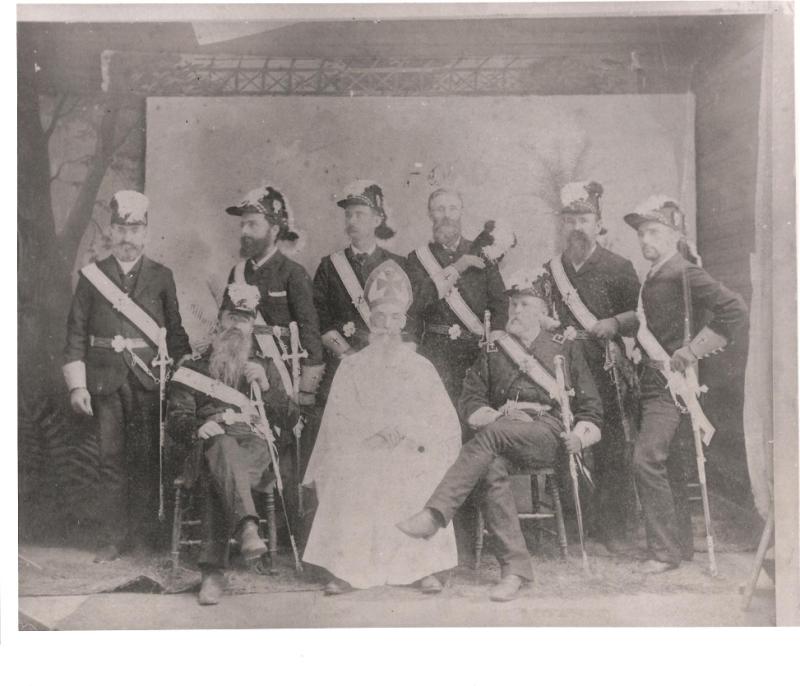
Phoenixmasonry records on its website the existence of a White Supremacist organization with Masonic influence called Knights of the Golden Circle.
The Knights of the Golden Circle was a Texas-based secret society. Their objective was to create a confederation of slave-holding states in parts of Mexico and the West Indies, extending slavery; the group’s plan thus mirrored the objectives of secession, a cause they actively supported during the Civil War. Legend has it that they hid the fabled confederate gold allegedly sent off for safe keeping as the waning days of the war. Others have linked them to the KKK.
At the link below is a fascinating history of the KGC and the historical context, it is after all subtitled “A History of Secession from 1834 to 1861.” It was written by a member of the order and published in 1861. The rituals and degree structure described in this book clearly indicate the influence of Freemasonry; whether it was founded by men who happened to be Masons is unclear, as Freemasonry is not mentioned in the text. (1)
“A History of Secession from 1834 to 1861″
http://www.freemasoninformation.com/2012/12/freemasonry-and-the-knights-of-the-golden-circle/#respond
INTRODUCTION
Few people know of the Knights of the Golden Circle and even fewer know about the purpose for which it existed. It is probably the greatest untold story today in the history of the United States. That is unusual because during the last century this very large, powerful, secret and subversive southern organization had such a profound influence and effect over the course of many years that they almost succeeded in changing the course of our history.
It has been said of them that they were one of the deadliest, wealthiest, most secretive and subversive spy and underground organizations in the history of the world. It is known that they operated not only in the United States, but also around the glove for 65 years (1851 to 1916). Also, that the original Ku Klux Klan was their military arm. Some of the finest and craftiest brains in the South helped organize and direct the activities of the Knights of the Golden Circle. The group was heavy on ritual, most of which was borrowed from the Masonic Lodge and later from the Knights of Pythias. Some were also members of the Rosicrucians. Their wealth was due to the huge amount of money, valuables and equipment that they had accumulated for the purpose of restarting the Civil War.
So, you might wonder then if that is true, why haven’t we read about them in our history books or heard them mentioned in our schools before? That is a hard question to answer, but maybe because they were such devout, die-hard, southern rebels, working for a southern cause that was eventually defeated and one that is not popular today. However, the fact remains that since they did exist and were a very large and powerful organization for many years, I think that their story should be known today.
But during the 1800′s, many stories and articles did appear about the Knights of the Golden Circle in many newspapers, magazines and periodicals, before, during, and after the Civil War. But somehow, these stories have been overlooked or purposely omitted from our modern-day history books. So, who were the Knights of the Golden Circle and what was their purpose?
Origins of the Knights of the Golden Circle
Actually, their beginning goes back to a long period before the Civil War when our young nation was reaching out for more territory. They were part of the overall imperialist’s movement to expand out borders westward, even though they had not officially taken on the name of the Knights of the Golden Circle. Then, when the issue of slavery began to divide the sentiments of our country, they started to support the Southern states in trying to keep slavery alive because most of them were Southerners. As the issue of slavery finally divided the Union and the Civil War began, they became ardent supporters of the southern cause. This is when the organization became secret and went underground in their efforts to aid the Confederacy. Since they were considered subversive, that is why they became a secret organization. President Lincoln once referred to their very effective efforts against the North, as a “Fifth Column.” That could have been the origin of the term.
Then, after the war was over, they refused to accept the terms of the southern surrender. They had been working diligently for many years to accomplish their goals and were not about to give them up. They had too much momentum going. Also, they were still bitter over the issue of slavery and of not establishing a Confederate nation independent from the northern states. This is when they went underground with a strongly determined and clandestine, even bizarre, plan to eventually restart the Civil War at a later time.(2)
FURTHER UNDERTAKINGS AND MASONIC INFLUENCE
Shortly before the Civil War began, the state of Texas was the greatest source of this organization’s strength. Texas was home for at least thirty-two K.G.C. castles in twenty-seven counties, including the towns of San Antonio, Marshall, Canton, and Castroville. Evidence suggests that San Antonio may have served as the organization’s national headquarters for a time.
The South began to secede from the Union in January 1861, and in February of that year, seven seceding states ratified the Confederate Constitution and named Jefferson Davis as provisional president. The Knights of the Golden Circle became the first and most powerful ally of the newly-created Confederate States ofAmerica.
Before the Civil War officially started on April 12, 1861, when shots were fired on Fort Sumter, South Carolina, and before Texas had held its election on the secession referendum on February 23, 1861, Texas volunteer forces, which included 150 K.G.C. soldiers under the command of Col. Ben McCulloch, forced the surrender of the federal arsenal at San Antonio that was under the command of Bvt. Maj. Gen. David E. Twiggs on February 15, 1861. Knights of the Golden Circle who were involved in this mission included Capt. Trevanion Teel, Sgt. R. H. Williams, John Robert Baylor, and Sgt. Morgan Wolfe Merrick. Following this quick victory, volunteers who were mostly from K.G.C. companies, forced the surrender of all federal posts between San Antonio and El Paso.
Perhaps the best documentation as to the power and influence of the Knights of the Golden Circle during the Civil War is The Private Journal and Diary of John H. Surratt, The Conspirator which was written by John Harrison Surratt and later edited by Dion Haco and published by Frederic A. Brady of New York in 1866. In this journal, Surratt goes into great detail when describing how he was introduced to the K.G.C. in the summer of 1860 by another Knight, John Wilkes Booth, and inducted into this mysterious organization on July 2, 1860, at a castle in Baltimore,Maryland. Surratt describes the elaborate and secret induction ceremony and its rituals and tells that cabinet members, congressmen, judges, actors, and other politicians were in attendance. Maybe the most significant revelation of Surratt’s diary is that the Knights of the Golden Circle began plotting to kidnap Abraham Lincoln in 1860, before Lincoln was even inaugurated in 1861, and continued throughout the Civil War, resulting in President Lincoln’s assassination by fellow Knight Booth on April 14, 1865.
After trying unsuccessfully to peacefully resolve the conflicts between North and South, the Knights of the Golden Circle threw its full support behind the newly-created Confederate States of America and added its trained military men to the Confederate States Army. Several Confederate military groups during the Civil War were composed either totally or in large part of members of the Knights of theGolden Circle. One notable example of K.G.C. military participation in the Civil War included the Confederate’s Western Expansion Movement of 1861 and 1862 led by Lt. Col. John Robert Baylor and Gen. Henry Hopkins Sibley.
In 1861 Albert Pike travelled to Indian Territory and negotiated an alliance with Cherokee Chief Stand Watie. Prior to the beginning of hostilities, Pike helped Watie to become a Thirty-second Degree Scottish Rite Mason. Watie was also in the K.G.C., and he was later commissioned a colonel in command of the First Regiment of Cherokee Mounted Rifles. In May 1864 Chief Watie was promoted to the rank of brigadier general in the Confederate States Army making him the only Native American of this rank in the Confederate Army. Watie’s command was to serve under CSA officers Albert Pike, Benjamin McCulloch, Thomas Hindman, and Sterling Price. They fought in engagements in Indian Territory, Kansas, Arkansas, Texas, and Missouri.
One of the most feared organizations of all Confederates, whose members were in large part Knights of the Golden Circle, was what was called Quantrill’s Guerrillas or Quantrill’s Raiders. The Missouri-based band was formed in December 1861 by William Clark Quantrill and originally consisted of only ten men who were determined to right the wrongs done to Missourians by Union occupational soldiers. Their mortal enemies were the Kansas Jayhawkers and the Red Legs who were the plague of Missouri. As the war raged on in Missouri and neighboring states, Quantrill’s band attracted hundreds more men into its ranks. Quantrill’s Guerrillas became an official arm of the Confederate Army after May 1862, when the Confederate Congress approved the Partisan Ranger Act. Other leaders of Quantrill’s Guerrillas included William C. “Bloody Bill” Anderson, David Pool, William Gregg, and George Todd. Some of the major engagements this deadly guerrilla force participated in included the Lawrence, Kansas, raid on August 21, 1863, the battle near Baxter Springs, Kansas, in October 1863, and two battles at and near Centralia in Missouri in September of 1864. The bulk of Quantrill’s band wintered in Grayson County, Texas, from 1861 through 1864. (3)
From “A History of Secession from 1834 to 1861″ comes this insight into the rituals of The Knights of the Golden Circle. This entire work is rather lengthy but very revealing and is available in full on Phoenixmasonry.
I will now give you the signs, grips, password, and token of the First Degree of the K. C. G. (Of course a misprint for K. G. C.)
This Dcgree has a name, which I may now give you—it is the ” I,” (Knight of the Iron Hand.) The first great sign of the…
Order is thus made, 7, (Hands open, palms touching and resting on the top or the head, fingers pointed upwards). The answer to this is 8 (open hands touching shoulder where epaulettes are worn ; elbows close to the side).
These are battle-field signs, and are not to be used under ordinary circumstances. The common sign of recognition is 9 (right forefinger drawn across upper lip under nose, as if rubbing). The answer 10, (with forefinger and thumb of left hand take hold of’ left ear).
To gain admission to a Lorking Castle, or the room of any K. G. C., give 11 (one distinct rap) at the door, The Sentinel on duty will then raise the wicket and demand the countersign, which is 12, (SOLDIERS, always lettered except at Castle door.) You will then pass to the center of the room and give the true sign of the K. G. C.; it is 13. (left hand on heart; right hand raised) This will be recognized by a bow from the Captain, when you will at once take your seat. The sign of assent is 14, (both hands up) of dissent 15, (one hand tip) the grip is 16, (press with thumb one inch above second knuckle) the token 17, (Golden Circle encasing block bands closed on scroll : the whole to be the size of a dime)
Every member may wear the sign of his degree.
And now, reader, yon know as much about the signs, grips, tokens, &c., of the Knights of the Golden Circle as they themselves do. We may here remark that the initiation fee for the First Degree is one dollar, for the Second five dollars, for the Third ten.
From the Second or Financial Degree we need give but little.
The following is the closing part of the initiation:
Captain. The head quarters of this organization are at 23, (Monterey) where most of the stores and munitions are deposited. The Financial Head quarters are at —; Col. N. J.Scott is at present Financial Chairman.
Inspector.
KNIGHTS OF THE GOLDEN CIRCLE. 83
Captain. I shall now give you the unwritten parts of this work, and I trust you will be careful in its use. If a general war ensues, we shall dispense with the First Degree, and rely on this and the Third.
Name—18 (True Faith) sign—25 (fore finger and thumb of right hands joined, while with thc rest of the hand upon the right eye is touching with the middle finger,) answer—26 (same with left hand and left eye) password 27 (Monterey) night word of distress-32 (St Mary) response-3I and say 5 (grasp by wrist and say Rio Grande emblem—28 (gold circle encasing Greek cross, in center of which is star) This is the 29 (key) to our 30 (secret alphabet) use of 33 (K. G. C.) 56 (Gcorge ley) guard sign 28 (gold circle encasing Greek CROSS, in center of which is a star) silence 25 (forefinger and thumb of right hand joined, while with the rest of the hand open the right, eye left is touching on middle finger) on lips; danger—right—same with and now it remains for us to give the Ritual of the Third Degree, which, as being the most importaut, we shall publish almost entire. We have not the time or space for commenting on it now.
Every citizen can judge of it for himself: The Roman Catholics and the foreign born population will see how they are proscribed by this mysterious Order ; this central and guiding power of the secession and disunion party. All will see, too, that the Order declares for a Monarchy, a Limited Monarchy, as they call it, until all their purposes in regard to Mexico shall have been accomplished, and we need not suggest how bricf will be the period within which, if they get their Limited Monarchy, they will make it an Absolute Monarchy.
THIRD or POLITICAL DEGREE OF THE 33 (K. G. C.)— NAMED 57
(Knights Of the Columbian Star)
INSTRUCTIONS: Officers of the Council shall be a Governor and a Secretary. Every 57 (Knight of the Columbian Star) is qualified to act in either capacity.
Qualifications for Membership.
Candidate must be familiar with the work of the two former Degrees ; must have been born in 58 (a Slave State), or if in 59 (a Free State) he must be a citizen; 60 (a Protestant) and 61 (a Slaveholder). A candidate who was horn in 58 (a Slave State) need not be 61 (a Slaveholder) provided he can give 62 (Evidences of character as a Southern man).
Object: To form a council for the 33 (K. G. C.) and to organize 63 (a government) for 2 (Mexico.) No 57 (Knight of the Columbian Star) shall admit, except to a brother 57, that he has this Degree, for reasons that will hereafter appear. Any two 57s84 RITUAL OF THE can confer the degree on others, the oldest 57 acting as Governor.
Although it is pure conjecture one has to wonder whether present day Southern Freemasonry’s objection to recognizing Prince Hall, its insistence on being a White, Christian only Fraternity as exemplified by the recent religious rulings of the Mainstream Grand Lodge of Florida, has a direct correlation in the teachings of The Knights of the Golden Circle and other White Supremacist organizations being passed down from father to son, generation after generation.
(1) Phoenixmasonry – http://www.phoenixmasonry.org/masonicmuseum/fraternalism/knights_of_the_golden_circle.htm
(2) Knights Of The Golden Circle.net – http://knightsofthegoldencircle.net/Introduction.html
(3) Knights of the Golden Circle – http://knightsofthegoldencircle.webs.com/
(4) “A History of Secession from 1834 to 1861″
http://www.phoenixmasonry.org/masonicmuseum/fraternalism/An-Authentic-Exposition-of-the-K-G-C-Knights-of-the-Golden-Circle.pdf
The Knights of the Golden Circle Research and Historical Archives
http://groups.yahoo.com/group/Knights_of_the_Golden_Circle
http://knights-of-the-golden-circle.blogspot.com
http://knightsofthegoldencircle.webs.com
Subscribe to:
Posts (Atom)