Saturday, September 29, 2012

Jesse James Poisoned Lincoln's Assassin


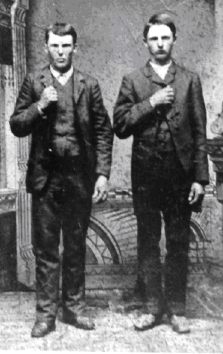
Jesse_and_Frank_James.jpgAfter he was poisoned for breaking his Masonic oath of silence, John Wilkes Booth's corpse was rented out to carnivals and sideshows.

(Brothers Jesse,left, and Frank James strike a Masonic pose) 


Let's rewind.
Booth's heavy drinking combined with his continual boasting of exploits within the KGC eventually brought him to the attention of Jesse James. It was also reported that Booth regularly partook of laudanum, an opium derivative. This is when he would become particularly verbose.


Again we have to rewind...
The outlaw Jesse James was not killed by Bob Ford in 1882. Jesse faked his death as an expedient way to throw off Pinkerton agents, assorted railroad barons, gun fighters and the bounty hunters scouring the country for him.
He and Ford would become partners in many business ventures spanning decades. James operated under more than 50 aliases in his long life before dying at the advanced age of 107 under the alias J. Frank Dalton in 1951 in Lawton, Oklahoma.
Jesse was a 33rd degree Freemason and a high-ranking Knight of the Golden Circle.
The KGC evolved from a Scottish secret group known as The Society of the Horseman's Word, otherwise known as the Horse Whisperers. This fraternity recited passages from the Bible backwards and practiced folk magic as part of their rituals, in addition to having Masonic-style oaths.
Headquarters for the Knights of the Golden Circle was 814 Fatherland Dr. in Nashville. This was the home of KGC operative Frank James, elder brother of Jesse James. Years later it became the Dixie Tabernacle, original home of the Grand Ole Opry.
The KGC claimed 200,000 members all over America during the war. All of the men in Lincoln's cabinet were Knights, save for Lincoln. The KGC was heavily financed by the London and Paris Rothschild brothers. Their goal was to foment as much chaos and discord as possible in order to keep the country divided and to usher in a Rothschild-owned central bank.
But Lincoln had his own plans. During his presidency, his 50% tariff jump-started the American steel industry, while his railroads, subsidies for mining, free land for farmers and free state colleges transformed a bankrupt cotton-exporting country into the world's greatest industrial power within 25 years.
Lincoln knew that he was waging a separate but equally brutal war against Rothschild-dominated Wall St. firms with his attempt to reassert government control of its credit. He put through anti-usury and other strict banking laws, sold bonds directly to the people and issued hundreds of millions of national currency.
With these reforms "The Great Emancipator" had signed his own death warrant.
Lincoln knew that his time was short. He confided to his bodyguard Ward Lamont a week before he was killed that he had a vision of his own death.
But there were powerful people that believed in him.
During the Civil War Lincoln negotiated a pact with Czar Alexander of Russia whereby the Russian Navy was sent into the ports of San Francisco and New York to help block the Rothschild ships that were running armaments to the South.
After the appearance of the Russian ships in American waters, the Rothschilds canceled contracts to build more blockade running boats. The Czar won the day for the North as Russia promised to go to war with any nation that attacked America.
In 1867 when the war ended and Lincoln was dead, President Andrew Johnson received a bill in the amount of $7.2 million for the rental of the Russian fleet. The Constitution forbids giving tax dollars to any foreign nation for any reason whatever except for the purchase of land. Johnson directed Secretary of State William Seward to purchase Alaska from the Russians for $7.2 million.
These details of 'Seward's Folly' have been excised from the historical record. This is because Imperial Russia was the only European country without a central bank. They were the greatest foes of the Rothschild Syndicate.
Also, since the time of the Empress Elizabeth, Russian Jews had been confined to an area known as the Pale of Settlement. Jews could not live beyond the Pale. Long ago attempts were made to remove all Jews from Russia entirely unless they converted to the Orthodox Church. The Pale of Settlement was the next best solution.
The Rothshchilds underwrote the Bolshevik Revolution of 1917. The murder of Czar Nicholas and his family was their revenge for the treatment of their co-"religionists" in times past and for daring to stand against the inauguration of a Rothschild dominated central bank.
And the Rothschilds also underwrote the financing of the Knights of the Golden Circle.
Their gold and dollars were laundered through a Montreal bank by  Confederate Secretary of State, Judah Benjamin, 'the brains of the revolt.' Benjamin was running so many Confederate spies out of Montreal that it was known as 'the second Richmond.'
Benjamin was very wealthy and owned a sugar plantation manned by 140 slaves. After the war, he fled Richmond and eventually wound up in London where he made a very comfortable living as a Queen's Counsel. It is difficult to get data on Benjamin as he burned his personal notes so frequently that one historian referred to him as a 'virtual incendiary.'
After the Lincoln assassination police found decoding sheets in Booth's Washington hotel room. A matching coding device was found in Benjamin's Richmond office.
Returning to John St. Helen/David George/John Wilkes Booth
Jesse James was the treasurer and comptroller in sole possession of all gold & silver bullion and money of the Knights of the Golden Circle. In this capacity he paid Booth an annual pension of $3600 with the proviso that Booth honor his KGC oath of secrecy and never talk about their activities or the Lincoln assassination. He and other Knights repeatedly warned Booth to curb his loose tongue, but to no avail....
Jesse had no choice but to silence his Lodge Brother.
Jesse tracked Booth to the Grand Hotel in Enid one winter evening in 1903. Jesse made Booth drink a large glass of lemonade laced with a copious quantity of arsenic. Booth drank the lemonade and quickly expired. Jesse scattered many of Booth's papers around the corpse for easy identification. He then went down to the hotel lobby and gave the manager a gold coin and asked him to look in on his friend David George in the morning, as George was feeling ill.
The next day the press had a field day. The story exploded. Thousands of reporters came to Enid from all over the country to report the death of John Wilkes Booth.
Booth's body was taken to a mortuary across the street from the hotel that was owned by W.B. Penniman. Many people identified the corpse as Booth including a retired couple named Harper whom Booth had confided in.
Penniman embalmed the body and coated it with Vaseline. The arsenic went a long way to preserving the skin. Booth's attorney Finis Bates read the press reports in Memphis and hastened to Enid where he identified the body. A funeral trade journal in 1909 stated that within a few weeks the corpse had 'the drawn and tanned look of an old mummy.'
Penniman laid Booth out in his mortuary and charged curiosity-seekers 10 cents a peek. Tourists viewing the corpse would steal the collar buttons and sometimes remove locks of hair for souvenirs. One intrepid visitor tried to sever one of the mummy's ears with a pocket knife.
But when the drawing power of the Booth mummy waned, Penniman handed over the body to Finis Bates. Later on, Bates rented out the body to carnivals and sideshows.
The corpse traveled for years as part of a show featuring freaks and strange animals. It even emerged unscathed from a circus train wreck that killed eight people.
At one point the mummy was even kidnapped and ransomed. In 1931 it turned up in Chicago where a group of doctors performed an autopsy and took an x-ray and pronounced its Booth-like injuries authentic.
In 1932 a couple named Harkin bought the mummy and displayed it from the back of their truck. Hecklers would sometimes claim that the mummy was made out of wax, but Mrs. Harkin silenced them by rolling the mummy over and opening a flap on its back that had been cut away during the original autopsy. The mummy wore nothing but khaki shorts and between shows Mrs. Harkin would lacquer the skin with Vaseline and comb its hair.
Some wag declared that John Wilkes Booth was back in show business.....
The mummy vanished from the public eye in the 1950s.
--------------------------------------------
Mark Owen is a researcher living in Toronto. He can be reached at markowen10@hotmail.com
Part One- Lincoln Assassin Escaped
Some articles consulted:
Why the British Kill American Presidents by Anton Chaitkin, The New Federalist 1995
The Rothschild's International Plot to Kill Lincoln by Paul Goldstein, New Solidarity 1976
Why the Rothschilds Murdered Lincoln by Barbara Dreyfuss, New Solidarity 1976
The Mummy Mystery by Michael Finger, Memphis Flyer 2007
Some books consulted:
Escape and Suicide of John Wilkes Booth by Finis Bates 1908
Escape and Wanderings of John Wilkes Booth by WP Campbell 1922
Return of Assassin John Wilkes Booth by WC Jameson 1999
Lincoln Money Martyred by Fabius Melton Butler 1935
This One Mad Act by Izola Forrester 1937
Murdering Mr. Lincoln by Charles Higham 2004
The Lincoln Conspiracy by David Balsiger 1977
Jesse James United States Senator by Ralph Epperson 2005
Jesse James and the Lost Cause by Jesse Lee James 1961
Jesse James Was One Of His Names by Del Shrader 1975


Friday, September 28, 2012

Who Were The Knights of the Golden Circle


The KGC members were a feared people. They were organized in 1854, with their headquarters in Cincinnati. They had secret symbols, passwords and other conspiratorial paraphernalia. They created real violence for many years. The management of the Knights, spread like wildfire all through the South. Their many rituals turned quickly to violence and conquest as they attempted to establish a slave empire encompassing Florida in the Southern United States, the West Indies, Mexico and parts of Central America.

This was an area comprised of nearly 2400 square miles, -hence the name Golden Circle.
The Knights had hoped to control the commerce of the area and have a virtual monopoly on the worlds supply of tobacco, sugar in the hopes of the South’s rising to power again in the future. To accomplish this mission, meant finding the ability to accumulate millions of dollars, to include gold coins, goods and weaponry, and have it set aside for later use.

The Knights buried their accumulated possessions in elaborate man-made mine shafts, in many of the Southern States, and also included several hidden caches in the Western United States. South Dakota is one of those states. It is estimated that 4 million dollars in gold, weapons and the like was hidden in the western part of South Dakota. Several of these caches have been located, but many still remain as an unfound secret. There have been lives lost in the attempt of recovering these caches. The majority of these caches employ unique death traps to keep them out of the hands of treasure hunters.

There are several words and statements that have been used in reference the KGC. They were known to be the wealthiest and the deadliest, most secretive underground organization in the history of the world. They were closely associated with the Ku Klux Klan. So you wonder, why haven’t I read about them in my history books, or for that matter even heard about them. That’s a hard question to answer. The stories may have been purposely omitted, but why? It is known that the vast amount of money and valuables these die hard southern rebels were accumulating was for the purpose of restarting the Civil War, but it never happened. Instead, most all the wealth that they had accumulated, still lies buried in many different spots throughout the United States.

Some of these caches have been located, but many more are still secreted away. Jesse James, a devoted train robber, was a full fledged member of the KGC. They used many signs, clues, carvings and even Latin phrases, Code words and even buried gun barrels(pointing a certain direction). Animals carved in stone(especially Turtles), and tree trunks forced to point to a certain direction.

should you stumble upon one of these caches. They were placed so as to cause the death of an unsuspecting treasure hunter. Along with Jesse James other members included Jefferson Davis, Bedford Forrest, and William Quantrill (leader of the Confederate guerilla outfit Quantrill's Raiders, with whom James rode). Some believe the society was created by the notorious Albert Pike, the subject of many a Masonic conspiracy theory.

The South did in fact have an extensive intelligence infrastructure and Albert Pike was a key figure in that intelligence network. The only real news here is the claim that Jesse James was a key figure within that intelligence community as well and of course, the business about The Knights of the Golden Circle.

The James Gang's train and bank robberies, it is claimed, were fundraising operations to finance the activities of the Knights of the Golden Circle, as well as to wreak general havoc with the plans of the Northern reconstructionists. James is also said to have been involved in supplying weapons and training to the Plains Indians, as a means of waging proxy war against the Union Army.

The Knights of the Golden Circle was "the most powerful subversive organization ever to operate within the United States." (Getler & Brewer, op. cit.) First, they schemed to have Abraham Lincoln elected president, so as to inflame the South and cause secession. Later, their subordinate, John Wilkes Booth, assassinated Abraham Lincoln and with KGC assistance, Booth escaped. (what was behind that?) The KGC did not officially disband until 1908.

According to novelist Norma Cox, in her book, The New Spoilers, she has the 12 charter members of the Golden Circle as including Jefferson Davis, Bedford Forrest, Jesse James, and William Quantrill. Some say Albert Pike was the creator of the Knights of the Golden Circle, but Cox doubts it.

*"It is Important to remember about such secret organisations is the fact that only the men at the top know the truth..."*

So the KGC have dispanded but what happend to their treasure and the maps leading to it?


*What to do if you find a Treasure Map*

Knights of the Golden Circle Treasure Maps of the KGC and the on-sight signs include many objects other than animals. If it is an object, consider what the object does. What is the item used for? Is it the item a tool? What does that tool do? This could give you a clue for what they are saying but you must consider the context. Always take a series of photographs of each item and place in the picture an indicator for direction and an indicator for size. That way you can sit next to the fire on a cold winter night and examine the object and understand the direction it points and the size it is. Many times there is much information in the measurements of each part of the object.

Now examine the item (non-animal) for its use. It if were say a knife, look to see where it is pointing but watch carefully for any reversal signs. The hilt might even divide the treasure and the point show the direction. The lengths may indicate how far to the two treasures. You see, a knife is designed to cut or divide. And although that may not be the use of your knife, it could be. You must read it all within the context. Spanish signs were usually incorporated into a KGC site. Many times the signs were merged to confuse a Spanish sign interpreter. .

Source - Treasure Maps of the Knights of the Golden Circle, Article 15, Map Signs
©2010, Dr. John Melancon

*Potential Burial Locations*
*Old Mill Sites*: It's said that KGC members were fond of burying treasure caches in and near sites that could be easily remembered and sought out again later. These locations included old grain or grist mill sites (and adjoining terrain), which were often used as cache burial locations.

*Smelters or Furnaces*: In days past, smelters and furnaces were commonly known and easily recognized focal points for folks living within a specific geographical area. These included not only furnaces or smelters for precious metals like gold and silver, but also included coal or coke ovens as well as charcoal ovens. According to a number of KGC researchers, KGC members or "Sentinels" buried treasure around or near sites such as these.

*Cattle Trails: *Cattle trails can be found throughout the Plains states, and the West and Southwest in general. The KGC buried caches along cattle trails, especially those that were well known at the time or were the most prominent or frequently used. Here's a tip for you, however: Don't get sidetracked by focusing on your average, cattle-going-to-water type of trail....place your focus instead on those trails where large numbers of cattle were driven, regardless of direction (for example, the old Chisholm Trail).

*Livery Stables and Blacksmith Shops: *Sites such as these were very prominent in the day-to-day life and society of the 1800s. Often, these two types of sites were combined in many rural communities of the day. If you're able to pinpoint the location of one of these as a potential KGC cache location focus your search efforts on the area immediately adjacent to or near the old livery or smithy, not inside the perimeter of the old structures themselves.

*Railroads:* Old railroad lines covered very large expanses of territory. When you're pursuing a KGC cache lead along railways consider the following points: Rights-of-way, water towers, switches or switch stations, and so on. Remember, something on or along that old railroad line was a key visual clue for the burial (and recovery) of KGC treasure caches.

*Coach Stations or Traveler's Inns/Taverns:* These sorts of early "motels" or lay-over locations were often used by KGC members because of their "strategic" locations along roads, trails, or rail lines. Again, your search efforts should be focused on the immediate vicinity and not the inside or atop the old structure sites themselves.


The Knights of the Golden Circle was a secret order, comprised of Southern Sympathizers during the Civil War. Their members were known as Copperheads. During that time of the War between the States, the word Copperhead, was considered a sinister word. It was a word used to cover all groups of Peace Societies and even militant groups that were working to overthrow the government. At one time they had been called traitors to the Union. Innocent bystanders thought they were simply people fighting for freedom of action and the pursuit of their own convictions.

Friday, August 17, 2012

Caribbean Project: Review: The Southern Dream of a Caribbean Empire, 1854-1861


Posted on August 17, 2012 by Hunter Wallace

Caribbean Sea

Robert E. May’s The Southern Dream of a Caribbean Empire, 1854-1861 recounts the story of the South’s vision of Manifest Destiny in the 1850s.

In the 1840s, the United States under President John Tyler and James K. Polk annexed Texas, went to war with Mexico, acquired California and the American Southwest, and settled the Oregon Question with Great Britain.

From 1848 to 1851, the North and South fought over the spoils of Western expansion in Congress – a polarizing contest over the admission of California as a free state ended with the Compromise of 1850 and nearly brought about disunion.

For half a century, the North and South had expanded west across the North American continent as equal partners in the Union. The slave states had expanded along with the free states under the terms of the Missouri Compromise.

The admission of California upset the sectional balance of power by admitting a free state south of the parallel 36°30 north. The polarizing debates over the Wilmot Proviso also put the South on notice that elements in the North sought to reserve all future territory to the free states.

In the 1850s, Robert E. May argues that Manifest Destiny became sectionalized over “the extension of slavery”: Northerners attempted to block the addition of new slave states in the West while the South began to nurture its own dream of empire in the Caribbean.

“The Southern Dream of a Caribbean Empire” intensified after the Kansas-Nebraska Act and the rise of the Republican Party in 1854 with its core Wilmot Proviso doctrine of the non-extension of slavery.

Southerners placed great hopes in three unfulfilled Caribbean acquisitions in the 1850s:

Cuba

No acquisition was more ardently desired in the South or better illustrates the Caribbean Dream than the long sought acquisition of Cuba which had been expected ever since Thomas Jefferson’s time:

“Occassionally southerners got so carried away by their own rhetoric about Cuba that their prose became erotic: “[Cuba] admires Uncle Sam, and he loves her. Who shall forbid the bans? Matches are made made in heaven, and why not this? Who can object if he throws his arms around the Queen of the Antilles, as she sits, like Cleopatra’s burning throne, upon the silver wares, breathing her spicy, tropics breath, and pouring her rosy, sugared lips? Who can object? She is of age – take her, Uncle Sam!”

Three attempts were made by Southern-controlled presidents to purchase Cuba from Spain: James K. Polk in 1848, Franklin Pierce in 1854, and James Buchanan in 1859.

The 1854 attempt produced the Ostend Manifesto which strongly implied the Pierce administration was willing to go to war with Spain to prevent British-inspired abolition and the Africanization of Cuba.

In 1848 and 1854, the Spanish government refused to sell Cuba. By 1859, Republicans in Congress were strong enough to block the acquisition of Cuba through purchase or war, and Spain was still unwilling to sell anyway.

The Venezuelan filibuster Narciso López cooperated with Southern expansionists in a failed attempt to conquer Cuba for Dixie in 1851. John Quitman, “father of secession,” close ally of Robert Barnwell Rhett, and governor of Mississippi, was even prosecuted in federal court for his involvement in an armed conspiracy to invade Cuba.

Virtually every major political figure in the Lower South in the 1850s – Rhett, Yancey, Davis, Toombs, Stephens, Benjamin and others – supported Cuban annexation which was something of a litmus test issue at the time.

Even Northerners like Stephen Douglas loudly championed Cuban annexation. The 1856 Democratic platform called for American ascendancy in the Gulf of Mexico.

Within Cuba, some planters correctly feared that British pressure upon the Spanish government would bring about the abolition of slavery and the demise of white supremacy, and some of them supported annexation for that reason.

If the sectional controversy over slavery had not put the brakes on American expansion in the 1850s, Cuba would have likely shared the fate of Texas and Florida.

Mexico

Mexico continued to be a fertile target for Southern expansion well after the Mexican War.

In 1848, President James K. Polk attempted to annex the Republic of Yucatán. The bill passed the House of Representatives only to be defeated in the Senate.

The Gadsden Purchase of 1853 resulted in the acquisition of southern Arizona and southern New Mexico. The original plan would have acquired a huge section of Northern Mexico including Baja California, Baja California Sur, Coahuila, Chihuahua, Sonora, Nuevo León, and Tamaulipas.

In 1858, President James Buchanan attempted to purchase Lower California, Sonora, and Chihuahua and establish a protectorate over Northern Mexico – his plan was blocked by Republicans in Congress.

During the War Between the States, Santiago Vidaurri, the governor of Nuevo León and Coahuila petitioned Jefferson Davis for annexation to the Confederacy. This was highly impractical though due to wartime considerations.

In the 1850s, countless private filibusters attempted to conquer parts of Northern Mexico. One such expedition was led by William Walker who invaded Baja California and attempted to annex Sonora before he was repulsed.

The Knights of the Golden Circle, the most colorful of all the antebellum Southern Rights organizations, was a predominantly Texas-based organization that regarded the conquest of Mexico as its primary field of operations.

When Louisiana seceded from the Union in 1861, its commissioners argued that Texas should secede for both states could cooperate in the Southern Confederacy to complete the conquest of the Gulf of Mexico.

The Confederate secret service would attempt to engineer the secession of Veracruz from Mexico a few months later.

Nicaragua

Aside from Cuba and Mexico, Nicaragua proved to be the last major target for Southern expansion in the Caribbean in the 1850s.

In this case, Southerners pinned their hopes on William Walker – the “grey eyed man of destiny,” and the most successful filibuster in American history – who conquered Nicaragua in 1855 and restored slavery there in a bid for Southern support for his legitimacy in 1856

Although the U.S. opposed filibustering, arrested Walker, and never seriously considered annexing his shortlived regime, William Walker became a hero in the Lower South and was one of the most well known men of his times.

Walker was a romantic figure who attracted support from Northerners and Southerners alike before he played the slavery card in an attempt to save his regime.

“Thus even his individualism is a mere denial of anything higher, and not an affirming of his own soul. The extraordinary man is the one who puts something else before his own life and security. Even as he faced the firing squad, William Walker could have saved his life by merely renouncing his claim to President of Nicaragua. To the common man, this is insane.”

In 1860, William Walker was executed by a firing squad in Honduras at the age of 36 during his final bid to reconquer Nicaragua. Francis Parker Yockey exalts him above as the embodiment of Faustian man in Imperium although the circumstances of his death were due to more to British resentment of his actions on Ruatan and the Mosquito Coast.

A Dream Deferred

The Southern Dream of a Caribbean Empire was blocked by Northern Republicans, internal division within the South, resistance from Spain and Mexico, and the outbreak of the War Between the States.

After leaving the Union, Southerners temporarily disavowed their imperial ambitions in a bid for European recognition and support, and to keep Mexico neutral and a useful partner in circumventing the Yankee blockade of the Southern coast.

The destruction of the Union also eliminated a major rationale for Caribbean expansion because there was no longer any need to retain parity with the free states in the Senate.

In the final two chapters, Robert E. May makes an interesting argument that Caribbean expansion was the poison pill that killed the Crittenden Compromise and destroyed the only chance to save the Union in 1861.

Why the Hispanic Caribbean? Why not the British Caribbean or French Caribbean? I could quibble with this book over any number of points, but it is fairly obvious that Cuba and Mexico were targeted for their relative weakness, whereas major acquisitions from Britain and France were outside the realm of possibility.

May shows his bias when he fails to blame Yankee extremism for causing of the War Between the States. Cuba or Lower California could have been added as slave states as easily as Missouri or Texas without recourse to secession and armed conflict.

He could have also spent some time analyzing postbellum American expansion in the Caribbean: Grant’s attempt to annex the Dominican Republic, the Spanish-American War, the creation of the Panama Canal, etc.

This book is still a good read. It is a launching pad for a broader inquiry into U.S. foreign policy in the Caribbean and Latin America. Slaveowners may have dreamed of a Caribbean Empire, but the Yankee created real Banana Republics.

That’s something we will turn to later.

http://www.occidentaldissent.com/2012/08/17/caribbean-project-review-the-southern-dream-of-a-caribbean-empire-1854-1861/

Thursday, August 16, 2012

GC 35: Knights of the Golden Circle


Today, on the Golden Circle podcast we talk about the interesting life and times of George Bickley, the Knights of the Golden Circle (KGC), the origins and operations of the KGC, why Southern expansionism was popular (especially in the Lower South) in the mid nineteenth century and what happened to Bickley and the Knights when the Southern States seceded.

http://southernnationalist.com/blog/2012/08/14/gc-35-knights-of-the-golden-circle/

Click here for the audio
http://southernnationalist.com/blog/wp-content/uploads/2012/08/GC-035.mp3

The Knights of the Golden Circle Research and Historical Archives
http://groups.yahoo.com/group/Knights_of_the_Golden_Circle
http://knights-of-the-golden-circle.blogspot.com
http://knightofthegoldencircle.wordpress.com

Thursday, August 2, 2012

Pike Frightened By A Ghost


While we have covered this before it is interesting to see that it is still being reported in a current blog. We are not surprised that Brother Albert Pike would have recognized the visage of John Wilkes Booth, or someone who could have been his twin, we can only wonder as to the cause of his reaction. Was Brother Pike surprised to see Booth after his death or frightened to see Booth in his vicinity? Would the presence of Booth implicate Pike in the conspiracy to assassinate Lincoln or was the ghost of Booth a portent of Pikes own mortality?
ed
 
Pike Frightened By A Ghost
Posted on July 21, 2012
http://ersjdamoo.wordpress.com/2012/07/21/pike-frightened-by-a-ghost/
 
Colonel M.W. Connolly, a “distinguished newspaper man”, wrote that in 1883 he met “David E. George” (John Wilkes Booth) in Village Mills, Texas. Later, Colonel Connolly moved to Fort Worth where he worked as a newspaper editor. One evening, the Colonel was in the Pickwick Hotel barroom having a chat with Albert Pike, notorious Master Mason. The year was either 1884 or 1885 as the Colonel recalled. Then “David E. George” entered the room. Albert Pike, upon seeing “Mr. George”, became quite agitated. “My God! John Wilkes Booth!” Pike exclaimed. Colonel Connolly described how Albert Pike “was much excited” and “trembled like an aspen.” Pike fled to his hotel room. (Source: Chapter XV, “General Pike Identifies Booth”, The Escape and Suicide of John Wilkes Booth, by Finis Bates)
 
Why was Albert Pike so afraid? Did he believe in ghosts? Why didn’t Pike, a Confederate General during the Civil War, bravely charge forward and confront the suspect? Could it be that Albert Pike was afraid of what Booth knew? Did Pike fear Booth as a potential witness who could have helped send Master Mason Pike to the gallows?
 
Jesse James and his kinfolk were descendants of King James VI of Scotland, according to a recent book by Ron Pastore and John O’Melveny Woods (Jesse James’ Secret). Albert Pike was elected Sovereign Grand Commander of the Scottish Rite Freemasonry’s Southern Jurisdiction in 1859. This “Southern Jurisdiction” had been founded in Charleston, South Carolina in 1801. South Carolina thereafter became a hotbed of secession. In 1832, a theory that states could nullify federal law was put to the test in the Nullification Crisis, after South Carolina passed an ordinance that nullified federal tariffs. President Andrew Jackson was furious about this, and a “Force Bill” was passed which gave Jackson authority to use military and naval power against South Carolina. Jackson was especially angry at John C. Calhoun of South Carolina, who was then transitioning from Jackson’s Vice President to U.S. Senator. President Jackson wanted to have Calhoun arrested and “hung in chains” for treason. (Further details are in my book, What Would Millard Do?, published by Lulu.com)
 
So we have a strong undercurrent of Scottish as a common thread. And of course it was in South Carolina where the Civil War began, when that Scottish Rite state was first to secede from the Union. Albert Pike had become “Sovereign Commander” of the Southern Jurisdiction Scottish Rite in 1859, shortly before Fort Sumter happened in South Carolina in 1861.
 
Jesse James, of the royal Scottish King James VI bloodline, and Albert Pike were among the twelve charter members of the Knights of the Golden Circle, a secret society. John Wilkes Booth belonged to another secret society, the Knights of the White Camellia. Was the umbrella sheltering those two bands of “Knights” the Scottish Rite Freemasonry, Southern Jurisdiction? Were “Knight of Golden Circle” and “Knight of White Camellia” merely ranks, or “degrees” within the Scottish Rite?
 
Pastore and Woods (op. cit.) plan a future book dealing with a much deeper secret society agenda than a mere “War Between the States.” Based on patterns found in maps, they claim to have unlocked a “geometric puzzle”, the true legacy of the medieval Knights Templar, from which the Knights of the Golden Circle descended.
 

Thursday, July 12, 2012


Selected bibliography for Knights of the Golden Circle and selected downloads
http://digital.library.schreiner.edu/sldl/pdfs/SelBib0324.pdf

Background
Knights of the Golden Circle (KGC)
http://digital.library.schreiner.edu/sldl/hcc/kgc.html

EXCERPT: "In 1854, Virginia-born George W. L. Bickley organized the covert Knights of the Golden Circle to establish a commercial empire based on the expansion of slavery into the West Indies, Mexico, and parts of Central America.  With the southern United States included, the area would become a “Golden Circle” intended to control commerce in tobacco, sugar, rice and coffee; the annexation of Mexico was the ultimate goal.

Bickley’s scheme was one of many that simmered beneath the surface of America’s republican crisis exacerbated by congressional decisions over the extent of slaveholding: the Missouri Compromise of 1820, the Gag Rule of 1836, the Wilmot Proviso, and the Compromise of 1850.  Because the extension of slavery into the Mexican cession was part of the controversy, Texas became the location of thirty-two local chapters of the Knights.  In 1860, these “castles” provided support for unsuccessful attempts to invade Mexico from Texas.

Although the organization became less visible as the American Civil War progressed, it operated as a fifth column and boasted that its membership included prominent Americans from both sides of the conflict.  The Union arrested Bickley for spying in 1863 and held him as a prisoner until the end of the war."

The Bylaws of the Castroville Castle of the KGC  (5 image files | 1 PDF)
http://digital.library.schreiner.edu/sldl/hcc/bylaws.html
http://digital.library.schreiner.edu/sldl/collection/HCC/KGC/pdfs/bylws_trnsc.pdf

An Exposition of the KGC  (1 image file | 2 PDF’s)
http://digital.library.schreiner.edu/sldl/hcc/expos.html
http://digital.library.schreiner.edu/sldl/collection/HCC/KGC/pdfs/Exposition.pdf
http://digital.library.schreiner.edu/sldl/collection/HCC/KGC/pdfs/expos_ocr.pdf

Military Degree  (13 image files | 1 PDF)
http://digital.library.schreiner.edu/sldl/collection/HCC/KGC/pdfs/mildgr.pdf

The Knights of the Golden Circle Research and Historical Archives
http://groups.yahoo.com/group/Knights_of_the_Golden_Circle
http://knights-of-the-golden-circle.blogspot.com
http://knightsofthegoldencircle.webs.com

Tuesday, July 10, 2012

The Empire of Knights of the Golden Circle

National Flag


“Strength and honor”


Regional Influence: Minnow
Location: the West 
Pacific
Overview • People • Government • Economy • Trend • Analysis
The Empire of Knights of the golden circle is a tiny, genial nation, renowned for its devotion to social welfare. Its compassionate, hard-working, intelligent population of 7 million have some civil rights, but not too many, enjoy the freedom to spend their money however they like, to a point, and take part in free and open elections, although not too often.
The government -- a sprawling, bureaucracy-choked morass -- is mainly concerned with Social Welfare, although Commerce and Religion & Spirituality are on the agenda. Citizens pay a flat income tax of 30%. A substantial private sector is led by the Soda Sales industry, followed by Automobile Manufacturing and Trout Farming.
Voting is compulsory, employers may fire workers without giving any reason, the automotive industry soaks up huge government handouts, and the grizzly bear is a protected species. Crime is moderate, probably because of the country's utter lack of prisons. Knights of the golden circle's national animal is the grizzly bear, which frolics freely in the nation's many lush forests, and its currency is the gold dollar.
Knights of the golden circle is ranked 826th in the West Pacific and 19,803rd in the world for Nicest Citizens, with 13 Smiles Per Hour (net).

http://www.nationstates.net/nation=knights_of_the_golden_circle